How do I teach my 9 year old about money?
By Calm Money Kids · 5 min read
A lot of parents get asked "how can I get more money?" around age 9, often right after their child spots something that costs more than their jar holds. You can teach a 9 year old about money by keeping their allowance steady, offering optional paid jobs that solve a real problem, and showing them what everyday things cost. Together these teach that money is earned with effort and that it does not go as far as it seems.
What can a 9 year old understand about money?
Most 9 year olds understand that grown-ups work to earn money. They can do the math to see how many weeks of allowance something costs.
They are also old enough to notice ads and to want what their friends have.
This matters because your child is ready to connect effort with money. In Calm Money Kids, a 9 year old is a Goal Builder, and this is the stage where earning comes in.
What is new about teaching money at age 9 compared to age 8?
At 8, the big lesson was thinking before buying. At 9, the big lesson is where money comes from.
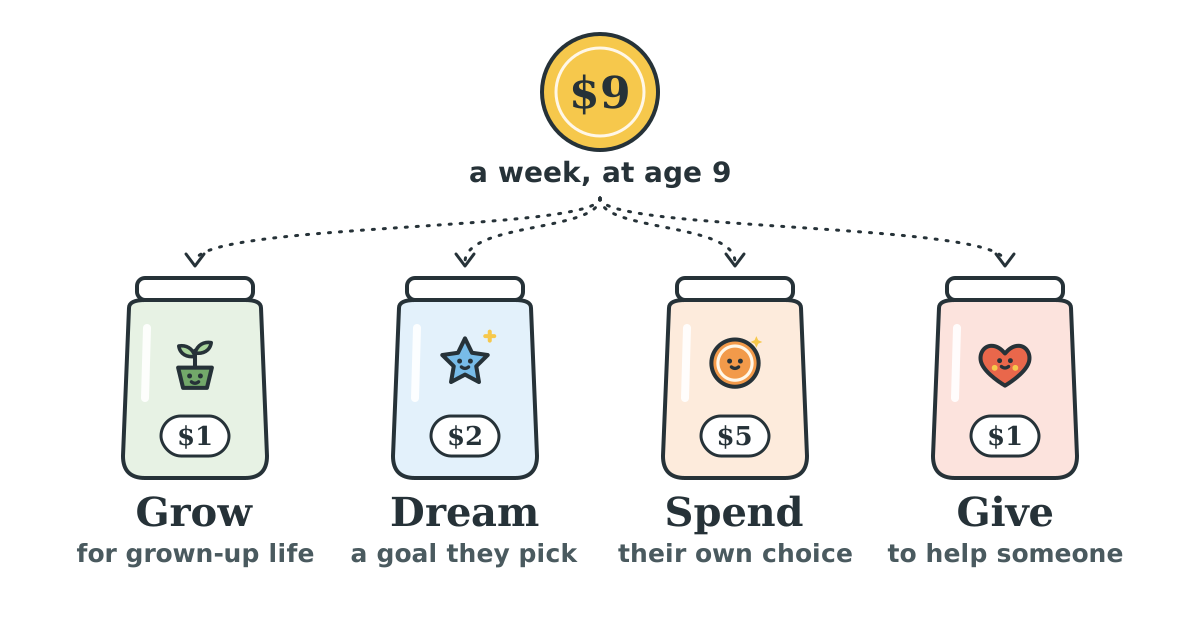
The suggested allowance goes up to $9 a week. The Spend jar gets $5, the Dream jar gets $2, and the Grow and Give jars each get $1.
The Spend jar now holds more than half the allowance, so your child has more to plan with each week.
When your child turns 10, you can read how to teach a 10 year old about money.
Why should your 9 year old learn about earning money now?
A child who only ever receives money can start to believe it simply shows up. That belief makes it hard to understand why a parent says no.
When your child earns even a few dollars through real effort, a price tag starts to mean something. A $10 toy becomes "all that work" and not only a number.
How can a 9 year old earn money without being paid for chores?
Calm Money Kids keeps three things apart, because mixing them changes what a child learns.
The allowance comes every week no matter what. Helping at home earns Helping Hands points, which are traded for privileges and shared experiences and never for money.
The third lane is Problem-Solving Gigs. These are optional paid jobs for solving a real problem, and they are always a choice and never something you expect.
A gig could be sorting out the messy shoe pile by the door so everyone can find their pair, or finding a way to stop the recycling bin from overflowing.
This matters because your child learns that helping is part of being a family and that earning is something extra they choose. The app keeps gigs in their own lane, so they never get mixed up with helping.
How do the four money jars work for a 9 year old?
On Family Money Day, your child splits $9 into four jars and checks the totals with you.
 The Grow jar gets $1 for the long run
The Grow jar is for life after 18. At 9, you can start to explain where grown-ups put money so it can grow.
Pick a company your child knows, like a favorite snack brand, and explain that a stock is a tiny piece of a company. This is only for learning, and it is not advice about what to buy.
 The Dream jar gets $2 for a goal that takes planning
With $2 a week, a goal of about $8 to $26 is in reach in one to three months. If a goal is too big, help your child pick a smaller first step.
 The Spend jar gets $5, and ads start to matter
At 9, your child is a target for ads. Pick one ad together and ask what it wants you to feel and what it wants you to do.
 The Give jar gets $1, and it can buy a gift
The Give jar can be used for other people in your child's life. Let your child buy a birthday gift for a friend from it, and talk afterward about how it felt.
How do you show a 9 year old what things really cost?
Say it is Friday night and you are ordering pizza for the family. Before you pay, show your child the total.
You might ask, "This dinner costs $27. How many weeks of your allowance is that?"
Your child works out that it is three weeks, and the number lands in a way it never did before.
This is not about making your child worry about money. It simply helps them see why a family plans how it spends.
What are three money activities to try with your 9 year old this week?
These three ideas each take a few minutes and fit into things you already do. You can try one this week and see what your child says.
- Offer one Problem-Solving Gig, agree on the pay before your child starts, and let them say no if they want to.
- Play guess the price with five things at the grocery store, and see who gets closest.
- Pick one ad together, and ask your child what it wants them to feel and do.
Common questions about teaching a 9 year old about money
How much allowance should a 9 year old get?
Calm Money Kids suggests $9 a week for a 9 year old, which is $1 for each year of age. That is $1 for Grow, $2 for Dream, $5 for Spend and $1 for Give.
Should I pay my 9 year old for chores?
In Calm Money Kids, no. Helping at home earns Helping Hands points, and the allowance stays the same every week.
What is the difference between a chore and a Problem-Solving Gig?
A chore is everyday helping that is part of being in a family. A gig is an extra job that solves a real problem, and your child is free to turn it down.
Help your 9 year old see where money comes from this week
A 9 year old is ready to learn that money takes effort and that it runs out faster than it looks. One gig and one honest look at a dinner bill will teach both.
Calm Money Kids keeps allowance, Helping Hands and gigs in separate lanes, so the lessons stay clear.